Kebuka


Basonym of Drug-Kebuka

Main Synonym-Kembukam, kevuka, kebuka

Botanical Name-Costus speciosus

Family-Zingiberaceae

Useful Parts -Rhizome

Important Phytoconstituent - Saponins, costusosides, diosgenin, tigogenin
Rasa Panchak

Rasa : Tikta, kashaya

Guna : laghu, ruksha

Virya : shita

Vipaka : katu

Action-Kaphapittahara

Therapeutic Indication - Kandughna (treat pruritus), kusthaghna (useful in skin disorders), deepen (appetizer), krimighna (anti-helminthic), balya (bulk promoting)
Dose -Rhizome powder - 3-6 gm, juice - 10-20 ml


Formulations
- Nishoshiradi taila, asanaeladi taila, krimighna Kash

Therapeutic Usage-

(1) Slipada- Juice of Kebuka rhizome is mixed with Vida lavana and the juice of Putranjivaka is given orally (S.S.CI, 19).

(2) Krmi- Juice of Kebuka is administered while keeping the individual on pungent diet (S.S.Ut. 54).

Research-

(1) The saponins of the plant were found to have significant anti-inflammatory and anti- arthritic activity against acute pedal inflammation induced by carrageenin in albino rats (Parikh et al., 1970).

(2) The saponins significantly increased the weight of uterus in spayed albino rats and the results being comparable to those produced by stilbesterol. The saponins produced pro- liferative changes in uterus and vagina which were similar to those produced by stilbesterol (Pandy et al., 1972, Singh et al., 1972).

(3) The alkaloids isolated from the plant possessed anti-cholinesterase activity both in vitro and in vivo (Bhattacharya et al., 1972).

(4) Alkaloidal fraction from rhizomes showed papaverine-like smooth muscle relaxant, an- tispasmodic, cardiotonic, hydrocholeretic, diuretic and CNS depressant activities in labo-

ratory animals (J.Res. Ind.Med. 1973,8.10).

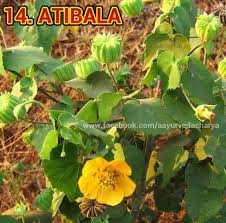
Atibala


ATIBALA

Botanical name - Abutilon indicum

Family -. Malvaceae
English name - country mallow
Hindi name - kakahiya
Synonyms - ATIBALA kanktika

Two type -  
1) chhoti. ( Abutilon indicum) 
2) Badi - Abutilon hirtum

Chemical constituents -. Musilage cells mostly present

Guna karma
Guna - Laghu snigdha pichchhila
Rasa - madhur
Virya - sita
Vipaka - madhura
 
Karma - vatapittasamak balya rasayan
Indication -- 
Mutrakruchh raktapradar shlipada

Parts use - panchang , seed 
Doses
Kwatha 50-100 ml 


Curna
3-6gm

Chemistry-
β-Sitosterol is present in A.
The root, bark, flowers, leaves and seeds are all used for medicinal purposes.

The leaves are used as adjunct to medicines used for pile complaints.

The flowers are used to increase semen in men.

Traditional medicine-
    Used as a demulcent, aphrodisiac, laxative, diuretic, sedative, astringent, expectorant, tonic, anti- convulsant,anti-inflammatory, anthelmintic, and analgesic and to treat leprosy, ulcers, headaches, gonorrhea, and bladder infection.
   
     The whole plant is uprooted, dried and is powdered. In ancient days, maidens were made to consume a spoonful of this powder with a spoonful of honey, once in a day, for 6 months until the day of marriage, for a safe and quick pregnancy. 


Pippali

 Pippali( पीपल)

Botanical name - Piper longum

Family - piperaceae

पर्याय-  मगधी, चपाला, कोल

Eng. Name -long Piper

MORPHOLOGY - An aromatic slender climber.

Chem. Compo -Caryophyllene

गुण-लघु, स्निग्ध

रस -कटु

विपाक - मधुर

वीर्य-उष्ण

कर्म -वात स्लेष्म हर

आमयिक प्रयोग- उदर, प्लिहारोग, ज्वार, कुष्ठ, प्रमेह, गुल्म, अर्स, सुल, अमवात

प्रयोज्यांग - फल, मूल

HOW TO USE PIPPALI:

1. Pippali Powder
a. Take ¼ -½ teaspoon of Pippali Powder.
b. Add honey and make a paste.
c. Apply on the affected area.
d. Wash thoroughly with fresh water.

विशिष्ट योग- पिप्पलियासव, पिप्पलियादीघ्रीत, पिप्पलियादी लेह

Pippali is an essential herb used in various Ayurvedic medicines. The roots and fruits of Pippali are used for its medicinal purposes. Fruits of this plant are slight yellow to orange in color and pungent in taste.

Pippali is an effective home remedy in managing cough and cold. Swallowing Pippali powder along with honey after lunch and dinner helps release mucus from the air passages due to its expectorant property, thus allowing the patient to breathe easily. It’s consumption might also help promote weight loss by improving the body’s metabolism. 


BENEFITS OF PIPPALI

What are the benefits of Pippali for Cholera?

MODERN SCIENCE VIEW

Although there is not enough scientific evidence available, Pippali has been traditionally used to manage cholera[4][7][9][10].

What are the benefits of Pippali for Epilepsy?

MODERN SCIENCE VIEW

Pippali contains a component that acts as a sedative and helps to manage seizures in epilepsy[4][8][15][16].

What are the benefits of Pippali for Asthma?

MODERN SCIENCE VIEW

Pippali contains certain compounds that have anti-asthmatic property. It may be beneficial in managing bronchial asthma in children[4][10-12].

AYURVEDIC VIEW

According to Ayurveda, Pippali helps to control the symptoms of asthma and provides relief in case of breathlessness. The main doshas involved in asthma are Vata and Kapha. The vitiated ‘Vata’ combines with the deranged ‘Kapha dosha’ in the lungs causing obstruction in the respiratory passage, resulting in difficulty in breathing. This condition is known as Swas Roga (asthma). Pippali is very useful in asthma because it has decongestant, bronchodilator, and expectorant activities due to its Kapha balancing property.

Tips:

1. Take 2-3 pinches of Pippali powder.

2. Swallow it with honey after lunch and dinner to manage the symptoms of asthma.

 Benefits of Pippali for Inflammation of Airways (Bronchitis)


Modern Science View:
Although there isn't enough scientific evidence, Pippali has been traditionally used to manage chronic bronchitis.

Ayurvedic View:
If you have cough-related problems like bronchitis, Pippali can be a helpful remedy. In Ayurveda, bronchitis is known as Kasroga, caused by poor digestion resulting from poor diet and incomplete elimination of waste. This leads to the formation of Ama, toxic remains in the body due to improper digestion, in the form of mucus in the lungs, which causes bronchitis. Pippali has Deepan (appetizer) and Pachan (digestive) properties. It reduces Ama and expels excessive mucus from the lungs, thus providing relief from the symptoms of bronchitis.

Tips:
1. Take 2-3 pinches of Pippali Powder.
2. Swallow it with honey after lunch and dinner to manage the symptoms of bronchitis.

Benefits of Pippali for diarrhea 


MODERN SCIENCE VIEW:
Although there is not enough scientific evidence available, Pippali may be useful in managing diarrhea due to its antidiarrheal properties.

AYURVEDIC VIEW:
In Ayurveda, diarrhea is known as Atisar. It is caused by improper food, impure water, toxins, mental stress, and weak digestive fire. All these factors aggravate Vata, which brings fluid into the intestine from various tissues in the body and mixes with the stool, resulting in loose, watery motions or diarrhea. Pippali powder can help control diarrhea because it has Vata balancing properties and improves the digestive fire due to its Deepan (appetizer) properties, which help control unusual motion frequency.

Tips:
1. Take 2-3 pinches of Pippali powder.
2. Swallow it with honey after lunch and dinner to control diarrhea.


Benefits of Pippali


What are the benefits of Pippali for headache?

Modern Science View

Although sufficient scientific evidence is not available, Pippali may be useful in managing headaches [4][9].

Ayurvedic View

Pippali may provide relief from headaches associated with the common cold. This type of headache is mainly due to excess Kapha. A paste of Pippali powder helps to reduce headaches due to its Kapha balancing nature when applied to the forehead.

Tips:

1. Take ½ -1 teaspoon of Pippali powder or as required.
2. Make a paste with water and apply it to the forehead.
3. Leave it for at least 1-2 hours or until the headache subsides.

What are the benefits of Pippali for toothache?

Ayurvedic View

Pippali helps to reduce toothaches when Pippali powder is rubbed on the gums and teeth. According to Ayurveda, the mouth acts as the seat of Kapha dosha, and an imbalance in Kapha dosha might lead to several dental problems like a toothache. Pippali helps to manage toothaches due to its Kapha balancing nature.

Tips:

1. Take ¼-½ teaspoon of Pippali powder.
2. Mix it with ½-1 teaspoon of honey to make a paste.
3. Rub the teeth once or twice a day to manage a toothache.


ayyappan


 AYYAPPAN

INTRODUCTION:


Eupatorium triplinerve (Vahl.), also known as ayapana (synonyms: ayapana triplinerve and eupatorium ayapana), is an ornamental herb that is widely used for medicinal purposes in countries such as Brazil, India, Sri Lanka, Bangladesh, Mauritius, West Indies, Peru, and Europe. Ethnobotanical studies have shown that the plant and its decoction are highly valued in traditional medicine. Phytochemical studies have revealed that the plant is rich in terpenoids and coumarin derivatives. The plant has been reported to possess analgesic, anti-inflammatory, antimicrobial, anticoagulant, and antioxidant properties.

BOTANICAL NAME- Eupatorium triplinerve

FAMILY- composite

SYNONYM-अजापर्ण

Morphology - shrub

chemical constituents - Ayappanin,Ayapin,keratin,vitamin-c

Rasa-Tikta,kashaya

Guna -laghu,Ruksha

Virya-ushna

Vipaka- katu

Karma-kaphapitta Hara,dipan,pacham,anuloman

Amayika prayog-   -agnimandya,ajirna, swasa,kasa,raktapradara,sitajwara

Dosage - 10 ml

Prayojyanga- panchanga

The following is a summary of the various activities of E. prostrata:


Antioxidant Activity:
In Charles River Sprague-Dawley rats, the extract of E. prostrata demonstrated antioxidant effects. The extract at 50 mg/kg and 100 mg/kg doses significantly reduced oxidative biomarkers such as serum lipid peroxide and serum hydroxyl radical levels.

Antimicrobial Activity:
The butanol and water extract of E. prostrata inhibited the growth of Bacillus cereus by 45% and 42%, respectively, at a concentration of 3 mg/disc. The highest growth inhibition of 63% for butanol extract and 54% for ethyl acetate fraction were reported against B. subtilis at the concentrations of 3 mg/disc. The butanol extracted sample showed inhibition of 57%, 72%, and 89% at concentrations of 1, 2, and 3 mg/disc, respectively, and that of ethyl acetate extract showed growth inhibitions of 40, 57, and 83% at concentrations of 1, 2, and 3 mg/disc, respectively.

Hepatoprotective Activities:
The aqueous extract of leaves of E. prostrata was administered to carbon tetrachloride (CCl4)-induced hepatotoxicity in male albino rats. The extract (250 mg/kg b.w.) reduced the elevated levels of all the biochemical parameters such as glutamic-oxaloacetic transaminase (GOT), glutamine-pyruvate transaminase (GPT), and bilirubin.

Anti Hyperlipidemic Activities:
Excess synthesis of triglycerides causes various symptoms such as type II diabetes mellitus, hypertriglyceridemia, and obesity. Diacylglycerol acyltransferase (DGAT) is a key enzyme of biosynthesis in the final step of the glycerol phosphate pathway.

Cerebroprotective and Nervous System Related Activities:
In a study on Wister albino rats, the hydroalcoholic extract of E. prostrata was found to have a cerebroprotective function. The extract administration gradually improved the antioxidant enzyme levels, decreased brain edema, and altered some histopathological status in mice after bilateral cerebral artery occlusion.

Anticancer Activities:
The methanol extract of E. prostrata administered orally at the dose of 250 and 500 mg/kg to Ehrlich ascites carcinoma (EAC) bearing mice increased the life span. It also decreased the viable cell count and tumor volume of the tumor-bearing mice when compared to that of control. As compared to EAC control, E. prostrata extract restored the hematological parameters such as red blood cells (RBC) count and hemoglobin content. In the treated group, the percentage of lymphocytes was increased with a decreased level of neutrophils.

CONCLUSION:

Eclipta prostrata is widely used as traditional medicine in various countries specially for skin, liver and stomach problems, and for promoting hair growth. Various compounds such as coumestan derivatives, steroidal and triterpenoid saponins, phenolic acids, flavonoids, and substituted thiophenes were isolated and identified from the extracts. Similarly, various biological activity evaluations were performed for extracts and isolated compounds such as antioxidative, antimicrobial, hepatoprotective, anticancer, hair growth promoting activities. Many of these activities were performed based on in vitro methods and mechanisms of action are not explored in detail using animal models. Properly designed clinical studies are necessary to evaluate the safety and efficacy E. prostrata in future.

BAKUCHI बाकुची


BAKUCHI बाकुची (कुष्ठघ्न)

 FAMILY - FABACEAE

LATIN NAME - Psoralea corylifolia

SYNONYMS(पर्याय) - कृष्णफला, कुष्ठघ्न, पूतिफली

Eng. Name - Psoralea seed

MORPHOLOGY - क्षुप

Chem. Compo- Psoralin,Raffinose,isopsoralen,Corylifolean

गुण - लघु, रूक्ष

रस - कटुतिक्त

विपाक - कटु

वीर्य - उष्ण

आमयिक प्रयोग - कृमिघ्न, त्वकदोषहर, व्रणरोपण,

श्वित्र, कुष्ठ, सोरायसिस, विबन्धहर

प्रयोज्यांग - बीज,तैल 

DOSE - 1-3 Gm

FORMULATIONS(विशिष्ट योग) - बाकुची-चूर्ण तैल,बाकुची रसायन, सोमराजी रसायन


Varieties of Bakuchi

According to chikitsa sathan in Shushrut samhita, there are two types of bakuchi:-

1. Shweta bakuchi

2. Krishna bakuchi

Practical Uses of Posralea corylifolia

One of the amazing fact about this herb is that whole plant is used in medicine system for its medicinal properties. Common name of this herb is kusthghan, it is best ancient remedy used for kusthroga and leucoderma.

This plant is natural blood purifier. It is used to boost immune system and process of detoxification of blood.

It has anti-cancerous, anti-inflammatory, anti-depressant and anti-hyperglycemis properties.

Seeds of this plant are diuretic, laxative and also used to cure poisoning by scorpion and snake bites

It is good to cure dyspnoea, asthma, bronchitis and various disorders associated with respiratory tract.

It is used to relieve indigestion and also used to cure worm infestation.

Seeds of this plant are used to cure various skin disorders.

Fruits of this herb are bitter in taste and used to stop vomiting.

Seeds of this herb are also used in tooth and bone decalcification.

Fruits are used to cure anemia, piles and various bleeding disorders.

It improves hair growth and useful in wound and ulcer healing.

It is anti-ageing and help to rejuvenate skin.

It is used to improve quality and luster of hair.

It is also a cardiac tonic and used to cure various problems associated with cardiac system.

It improves taste and used to cure anorexia.

It pacifies vata and kapha dosha,

Caution

Oil of this herb is very strong and excess use of this oil may cause skin discoloration.

कुमारी ALOEVERA

 कुमारी ( पित्त विरेचन)

FAMILY - Liliaceae

LATIN NAME- Aloe vera 

पर्याय- घृत कुमारी, ग्वारपाठा

Eng. Name - Indian aloe

MORPHOLOGY - क्षुप 2 फीट

Chem. Composition - Aloin

गुण- गुरू, स्निग्ध ,पिच्छिल

रस - तिक्त

विपाक - कटु

वीर्य- उष्ण

आमयिक प्रयोग- बल्य, वातविषहर, वृष्य, चक्षुष्य, रसायन, गुल्म, प्लीहा, यकृत, ग्रन्थि, अग्निदग्ध, रेचनी, अनार्तव

प्रयोज्यांग - पत्र, एलुवा

Dose- 0.1-0.2 gm

विशिष्ट योग- कुमार्यासव, कुमारिकावटी, कुमारिकापाक, रजःप्रवर्तनीवटी

Habitat

Ghritkumari is native to the Mediterranean region of North Africa, Canary Islands and Southem Europe. It is cultivated in USA, Mexico, Asia, southern Europe, Aruba, Bonaire, Bermuda, West Indies, the Bahamas, Central and South America. It spreads as wild in the coasts and coastal regions of south India. It also grows in parts of these cities, Maharashtra, Madhya Pradesh, Chhattisgarh and Gujarat.

Classical Categorization

There is no independent information regarding Ghritkumari observed in classical texts of Ayurveda.

In Samhitas-it is mentioned as a single drug and as one of the herbs used for making herbal formulations.

Acharya Sharangdhara explained one of the famous formulation of Ghritkumari in 13th century. It is known as Kumariasava.

Acharya Shodal introduced Ghritkumari in Nighantus in 14TH century.

Acharya Shodal described it as Kushthavinashini (drug destroy all kinds of skin diseases).

Acharya kaiyadeva mentioned kumari as rasayana means rejuvenator and vrasya means aphrodisiac

Kaiyadeva nighantu encloses the benefits of Ghritkumari flowers. They specified the flowers as a vermicidal


Practical Uses of Ghritkumari

It helps to stabilize blood sugar level, hence is good for diabetes.

It is helpful to cure burns and other skin disorders.

It give relief from wounds and ulcers.

It prevents growth of acne and moisturizes the skin.

It helps to treat fungus, insect bites, herpes, vaginal infections and allergic reactions.

Its juice is a tonic in conditions like jaundice, amenorrhea and piles.

It is antiseptic, helps to kill many of viruses and bacteria.

It helps to alkalize the body, balances acid production and treats constipation.

It prevents kidney stones, crohn's disease and IBS.

It also controls the levels of cholesterol and oxidative stress.

HOW TO USE ALOE VERA

1. Aloe vera juice
a. Take 2-3 teaspoons of Aloe vera juice.
b. Mix it with an equal quantity of water and drink immediately.
c. For better results, drink it preferably in the morning on an empty stomach.

2. Aloe vera capsule
a. Take 1 capsule of Aloe vera after meals or as prescribed by the doctor.
b. Follow this twice a day.

3. Aloe vera pulp
a. Remove the pulp from the inner side of fresh Aloe vera leaves.
b. Take about 1/4-1/2 teaspoon and add it to your favorite smoothie or fruit juice.
c. Blend well and drink it immediately preferably in your breakfast


बला BALA

 बला  (बल्य, रसायन) 

FAMILY-Malvaceae

LATIN NAME- Sida cordifolia

पर्याय -वाट्यालिका, खरयष्टिका, बरि यार, खिरैंटी, बीजबन्द

Eng. Name -Country mallow

MORPH-क्षुप

Chem. Compo-Ephedrine, Steroid,mu cin, KNO3

 गुण-लघु, स्निग्ध, पिच्छिल

रस-मधुर

विपाक-मधुर

वीर्य -शीत

आमयिक प्रयोग -रसायन, मूत्रजनन, वाजीकर, प्रदरहर, बल्य, क्षय, श्वासहर

DOSE-3-6 Gm

विशिष्ट योग-बलाद्य घृत-रिष्ट, चन्दनबलालाक्षादि तैल


Description of Bala plant

Bala botanical name is Sida cordifolia. Sida cordifolia is perennial herb that grows 30mts in height. Bala Leaves are oblong or ovate and are 2.5-7cm long and 2.5-5cm broad with 6-7 veins. Bala leaves are serrate, truncate and heart-shaped. Plant bears small, solitary, axillary and white or yellow colored flowers, Both Bala roots and stems are stout and strong. Bala Roots are bitter in taste, odorless and grayish yellow in color. Tap roots are generally branched at the tip. Bala Fruits are moong sized, disc-shaped and velvety in upper half about 6-8mm in diameter. Bala Seeds are smooth and grayish black in color and are called bajibanda in Ayurveda. Flowering season of plant is August to December and fruits appear from October to January.


Bala Habitat

Sida cordifolia is commonly known as bala, it is a common weed that grows along wastelands and roadsides and is native to India. Bala is found throughout tropical and sub-tropical regions of India and Sri Lanka. It is considered as invasive weed in Africa, Australia, Hawaiian island, Southern United States and New Guinea.


Practical Uses of Bala (Sida Cordifolia)


Bala is anti-inflammatory in nature and it is used to reduce the inflammation of wounds and eyes, its external application is used to reduce arthritis pain and other joint stiffness. Its external paste is used in ophthalmic disease and wound healing.

Oil prepared from this herb is very effective for the sufferers of cervical spondylitis, paralysis and facial paralysis.

Helps in the absorption of both water and nutrients from the intestine and very effective to control the motility of intestine. Due to these properties this herb is very effective in irritable bowel syndrome or grahani.

It is also used to reduce petechial hemorrhage and is used as cardiac tonic

Bala is used to treat both male and female infertility. In males it increases sperm count and used to increase motility of sperms. In Ayurveda this herb is called vrishya ie. Aphrodisiac. It is used teatreat mate erectile dysfunction and premature ejaculation.

It helps to rejuvenate urinary system and this herb act as diuretic and helps to treat cystitis.

Bala herb is used to reduce chest congestion and it is very useful for bronchitis, asthma and stomatitis.

Root infusion of Sida cordifolia is very effective for nervous and urinary system disorders. It is also used for treating blood and bile disorders.

It is used to pacify all three dosha vata, pitta and kapha.

Part used

Bala Roots,Bala Bark,Bala Leaves,Bala Flowers,Bala Seeds,

Dosage

Powder-3-6gms

Juice extract-10-20ml

Decoction-50-100ml

Cautions

Sida cordifolia contains ephedrine and excessive use of these herb causes:-

Insomnia

 Anxiety

Nervousness

Rise in blood pressure

Memory loss

 Stroke


SAIREYAK

SAIREYAK -सैरेयक (कुष्ठघन) Introduction -  It is a shrub growing upto Im. It will have yellow flowers and found in many parts of...